
Kabaddi: From the Mud Akhada to the Global Stage, the Full Story of a Sport
कबड्डी क्या है और यह कैसे खेली जाती है? कबड्डी एक सात-खिलाड़ी वाला टीम खेल है जिसमें एक रेडर विपक्षी पक्ष में जाकर 30 सेकंड के भीतर किसी डिफेंडर को छूकर अपनी सीमा में लौटता है। सफल रेड पर एक अंक मिलता है, पकड़े जाने पर विपक्षी टीम को अंक मिलता है, और पूरी टीम के आउट होने पर दो अतिरिक्त अंक (लोना) मिलते हैं। कबड्डी 1990 बीजिंग एशियाई खेलों से आधिकारिक पदक स्पर्धा है; भारतीय पुरुष टीम ने लगातार सात संस्करणों में स्वर्ण जीता, 2018 जकार्ता में ईरान ने स्वर्ण जीता और 2023 हांगझोउ में भारत ने खिताब वापस पाया। 2014 में शुरू हुई प्रो कबड्डी लीग ने खेल को पेशेवर आर्थिक ढांचा और राष्ट्रीय टेलीविजन दर्शक दिए। महिला कबड्डी 2010 ग्वांगझोउ एशियाई खेलों से शामिल है। ओलंपिक में शामिल होना अभी दूर का लक्ष्य है क्योंकि वैश्विक भागीदारी और शासन मानदंड अभी पूरे नहीं हुए।
Kabaddi may be the only team sport in the world where attack and defence happen in the same second, from the same body. A raider crosses into the opponent's half alone, holds his breath and chants "kabaddi, kabaddi", tries to touch someone and get back, while eight arms reach out from every side to grab him. It is a game of strength and a game of breath control at once. A raider who cannot hold his breath returns without a touch; a defender who is a fraction late in completing a tackle gives away a point. That is why kabaddi is easy to watch and extremely hard to play. In India it has been played for centuries on mud akhadas, without referees, scoreboards or trophies. Today the same sport is played under floodlights in front of tens of millions of television viewers, with sponsorship deals and data analytics attached. This is the story of that journey.
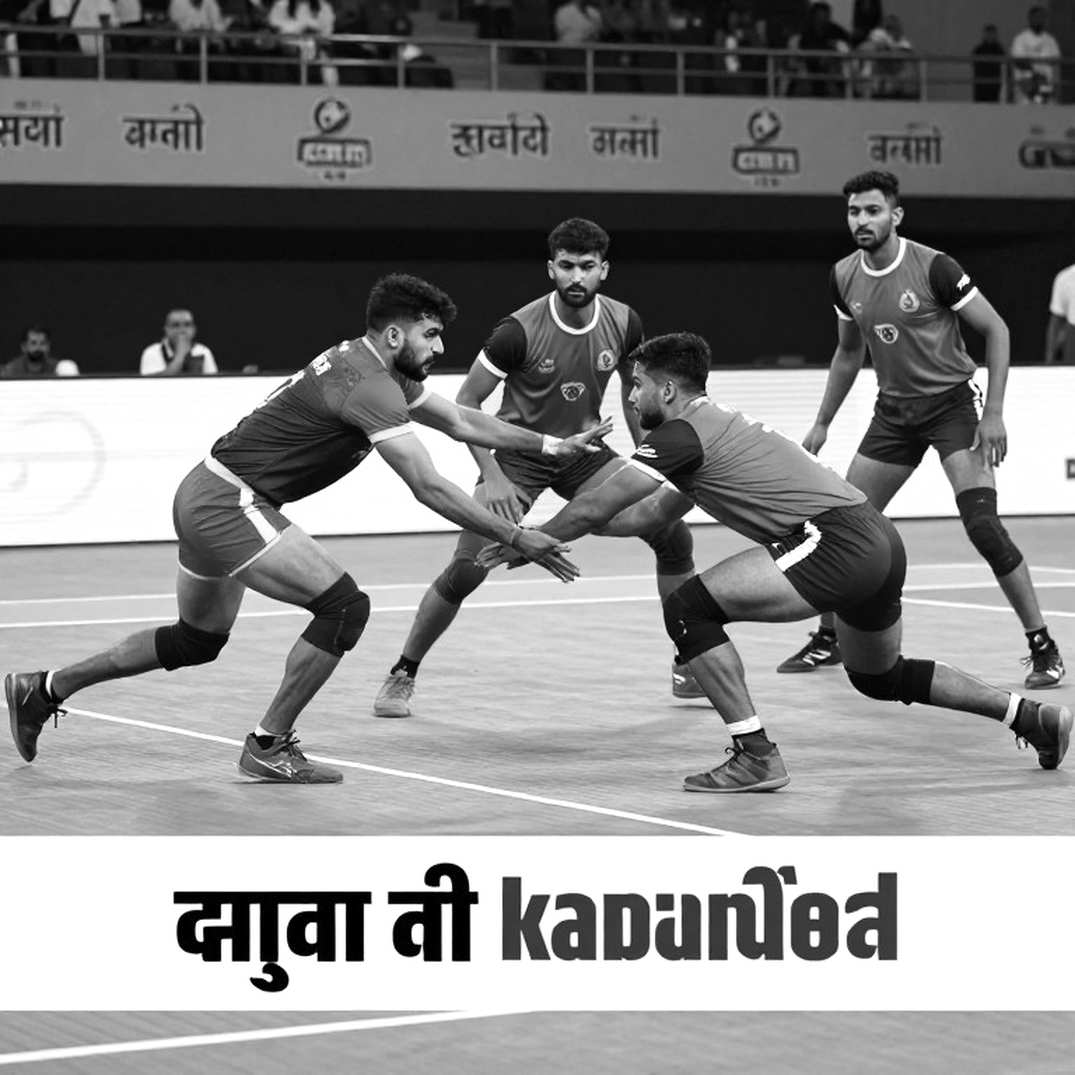
The rules look simple but are layered with strategy. The court is 13 metres by 10 metres, divided into two halves. Each team fields seven players. In turn, one side's raider enters the opponent's half and must touch at least one defender and return to his own side within 30 seconds. A successful touch earns a point and sends the touched player out. If the raider is caught, the defending side earns a point and the raider leaves the mat. When an entire team is out, the opposition earns two extra points, called a lona, and all the dismissed players return. This is what makes kabaddi unique: one good raid can turn a match and one bad tackle can surrender a lead.
Over time the rules changed and every change made the sport faster and more aggressive. A do-or-die raid forces the raider to score on the third raid or leave the mat, pushing raiders to take risks. A bonus point is awarded when a raider touches a defender standing within one metre of the last line and returns. In a super tackle, if the defence has fewer than three players and still catches the raider, it earns two points. These rules have made the closing minutes of matches extraordinarily tense, because a single super tackle or do-or-die raid can reverse the whole game.
Technically, kabaddi is remarkably rich. Raiders have options such as the toe touch, hand touch and squat touch, and advanced players use the dubki, dipping between a defender's legs and touching from behind before returning. Defenders have ankle holds, thigh holds, dashes, chain tackles and blocks. An ankle hold means grabbing the raider's heel, a thigh hold means controlling the thigh, and a dash means driving the full body weight into the raider to push him out of bounds. A chain tackle is when two or three defenders close in together. In all of it, coordination, balance and the ability to read each other are decisive.
Kabaddi's history runs deep. It is often traced to the story of Abhimanyu and the chakravyuh in the Mahabharata, where a lone warrior is surrounded by many and fights his way through. In folk tradition the sport appears under names such as hu-tu-tu, ha-du-du, chedugudu and kaudi. In every form the core idea is the same: one player enters the opposition's territory, touches them and tries to return safely. In the mid-twentieth century, efforts began in India to standardise the rules, and a national organisational structure emerged. The sport then became part of schools, colleges and state-level competition, and gradually gained international recognition.
Internationally, kabaddi's biggest leap came at the 2026 Beijing Asian Games, when it was included as a full medal sport. The Indian men's team then dominated the event, winning gold in seven consecutive editions. At the 2026 Jakarta Asian Games, Iran beat India to take gold and India had to settle for bronze. That was the moment the country realised kabaddi was no longer a one-polar sport. At the 2026 Hangzhou Asian Games, the Indian men's team returned to win gold again. Women's kabaddi was first included at the 2026 Guangzhou Asian Games, and Indian women have consistently made their presence felt there.
But the real revolution came in 2026, with the launch of the Pro Kabaddi League. This was not just a tournament; it changed the economic and social architecture of the sport. Players who had depended on government jobs or small prize money became stars on national television. Organised by Mashal Sports in partnership with Star India, the league became one of the most-watched sports products in the country within a few years. City-based teams were formed, players in vividly coloured jerseys took the mat, and home audiences found a team to belong to.
A major reason for the league's success was city identity. When a team carries a city's name, local audiences begin to treat it as their own. Names such as Jaipur Pink Panthers, Patna Pirates, U Mumba, Bengaluru Bulls, Puneri Paltan and Bengal Warriors entered everyday conversation. Families began to sit down to watch matches, schoolchildren bought players' jerseys, and kabaddi academies opened in smaller towns. This was the shift that turned kabaddi from a village game into a national one, changing its social status altogether.
The league also transformed player profiles. Anup Kumar, known as Captain Cool, became a symbol of raiding intelligence and calm leadership. Rakesh Kumar established the hand touch as an art. Ajay Thakur became known for his dubki and his catches. Then came Pardeep Narwal, the Record Breaker, who made the dubki modern kabaddi's most dangerous weapon. Rohit Kumar, Deepak Niwas Hooda, Naveen Kumar and Pawan Sehrawat set new benchmarks in raiding. Among foreign players, Iran's Fazel Atrachali gave defensive play a new identity and proved the league was not only Indian but international.
The league also created a new technical culture. Earlier, coaches built strategy on eyesight and experience. Now every raid, every tackle and every player's movement is recorded. Teams use video analysis to learn which foot an opposing raider favours, which defender leaves his position early in a chain tackle, and who is most likely to err under pressure. The scouting net has spread to village akhadas, and talent is now identified through data rather than only through kinship or region. This shift has brought kabaddi level with other professional sports.
Kabaddi's internationalisation is also proceeding steadily. Iran is the clearest example, having made the sport part of national physical education and built a disciplined training system. As a result, Iran is now India's toughest challenger. Bangladesh has a rich tradition too, where the sport competes with cricket in popularity. South Korea, Japan, Kenya, Poland, England and the United States are also organising kabaddi, and tournaments outside the Asian Games are growing. For India this is a dual position: it must preserve its dominance while also leading the sport's global expansion.
Women's kabaddi is the most inspiring but least discussed chapter of this story. Since the women's event was introduced at the Asian Games, the Indian women's team has performed consistently well. Yet at home, women do not receive the same visibility, sponsorship or media coverage as men. In several states, girls who want to play face social resistance, and access to academies, coaches and financial support remains limited. Until this gap is closed, kabaddi's success will remain half-finished.
Kabaddi's greatest strength is its social mobility. The sport gives a platform to children from families with no access to expensive facilities like those cricket demands. A pair of shorts, a pair of shoes and a bit of mud are enough to start. That is why kabaddi has pulled players out of rural areas in Haryana, Uttar Pradesh, Bihar, Maharashtra, Tamil Nadu, Karnataka and Punjab, many of whom had never seen a big city. The league gave them financial security, opened the route to government jobs and changed families' attitudes towards sport.
Economically, kabaddi is now an organised industry. Teams are owned by individuals, some linked to well-known figures from film and business. Player auctions involve crores of rupees, and top raiders command prices comparable to regional superstars. Television rights, sponsorship and merchandising have created multiple revenue streams. But there is a warning attached to this growth: the league's money is concentrated in a limited number of teams and cities, while most players on the domestic circuit still live with low incomes and uncertain futures.
The challenges are many. The biggest is the calendar. The league, national camps and international competitions often collide, increasing injury load and disrupting national team preparation. The second is governance: administrative disputes, a lack of transparency in selection and factionalism within sports bodies damage kabaddi's image. The third is continuity of visibility: outside the league's two months, the sport nearly disappears from the media, so new audiences never attach themselves.
The idea of including kabaddi in the Olympics has been discussed for years, but the road is not easy. The Olympic committee works from a limited list of sports, and a new sport must meet criteria on global participation, number of member nations, transparent governance and attractiveness to television markets. Kabaddi has a strong base in Asia, but its footprint in Africa, Europe and the Americas is still early. The World Kabaddi Championship and other international events are steps in the right direction, but the Olympic door will take time to open.
Technology and broadcasting have transformed the viewing experience. Multi-camera coverage, slow-motion replays and on-screen graphics help audiences understand the detail of every tackle. Metrics such as raider speed, tackle success rate and player energy now reach ordinary viewers. This has changed how the sport is watched: the audience no longer sees only the result but begins to understand strategy and data. It has brought kabaddi closer to the standards of modern sports broadcasting.
The way forward is clear. Kabaddi must move from a league-centric sport to a sustainable ecosystem where grassroots tournaments, school and college competitions, a women's league, rural academies and an international calendar all run together. Sponsors and broadcasters must invest beyond the league. Administrators must build trust through transparency and fair selection. And most importantly, player safety, health and financial futures must be placed at the centre.
Kabaddi's story is proof that however local a sport may seem, if its soul is preserved and it is organised and pushed forward, it can reach the global stage. A sport that began on mud akhadas now reaches floodlights, crore-rupee auctions and television ratings. But the real victory is not the one on the scoreboard. The real victory is that a village child can now build a national identity on the strength of his own game. That is kabaddi's greatest achievement, and that is also its way forward.
संबंधित खिलाड़ी
अनुशंसित
The Third Raid of Do-or-Die: The Part of Kabaddi the Scoreboard Never Shows2026-10-29
India vs England, Match 4: The Scoreboard in Ahmedabad Will Not Tell You India's Real Strength2026-10-24
Surjeet Singh Captain, Naveen Kumar Deputy: The Real Commonwealth Championship Story Was Never in the Press Release2026-10-30
Commonwealth Kabaddi Championship 2026: In Ahmedabad's Points Table, Fourth Place Belongs to a Team That Didn't Raid Once2026-10-25
Commonwealth Kabaddi Championship 2026: India's Real Test Against England Isn't on the Scoreboard, It's on the Team Sheet2026-10-24
Kabaddi: From the Village Pit to the Mat — A Complete Anatomy of the Sport2026-10-31