
Kabaddi: From the Village Pit to the Mat — A Complete Anatomy of the Sport
कबड्डी एक संपर्क-आधारित टीम खेल है जिसमें सात खिलाड़ियों की दो टीमें एक-दूसरे के क्षेत्र में घुसकर अंक कमाती हैं। हमलावर यानी रेडर को लगातार “कबड्डी” बोलते हुए विपक्षी आधे हिस्से में जाना होता है और निर्धारित समय के भीतर सुरक्षित लौटना होता है। डिफेंडर उसे पकड़कर या सीमा के बाहर धकेलकर रोकते हैं। मानक मैदान पुरुषों के लिए 13×10 मीटर और महिलाओं के लिए 12×8 मीटर होता है। अंक टच, टैकल, बोनस और ऑल आउट (लोना) से मिलते हैं। यह खेल भारत और दक्षिण एशिया में पारंपरिक रूप से लोकप्रिय है और अब पेशेवर लीग तथा अंतरराष्ट्रीय प्रतियोगिताओं में खेला जाता है।" } ```
Kabaddi is one of the very few sports in the world that needs no ball, bat, racket or any other external implement. The player's body is the tool, his breath is the clock, and his voice is the first condition of the rules. Two teams of seven, a court roughly thirteen by ten metres, and one compulsory chant — “kabaddi, kabaddi” — that is the entire architecture of the sport. A single raid usually lasts between thirty and sixty seconds, yet within that brief window strength, speed, balance, risk appetite and collective coordination are all tested at once. That is why kabaddi is far harder to understand than it looks.
Even the name is disputed. Some linguists trace it to the Tamil phrase “kai pidithu”, meaning “hold hands”, while others believe it simply emerged from the rhythmic chant a raider must repeat. Whatever the etymology, the character of the game is clear — it is a sport of holding and escaping, of entering and returning, of applying pressure and absorbing it. For centuries it has been played on mud courts across South Asia, where there was no referee, no scoreboard and no fixed duration. The twentieth century gave it organised form: written rules, defined boundaries and standardised competition.
Professional kabaddi today is played on a mat. The men's court measures 13 by 10 metres and the women's 12 by 8 metres. A midline divides the two halves. On either side of it lies the lobby, a zone that may be entered only during a raid and only without contact. Beyond that sit the baulk line and, one metre further, the bonus line. The strip between these two lines is precisely where scoring is both easiest and most dangerous for a raider. The mat surface, a three-metre clear area outside the boundary, and clearly marked lines all serve one purpose: to keep the pace high without compromising safety.
Each team fields seven players and keeps five substitutes. Of those seven, one is the raider, four are defenders deployed as corners, insides and covers, and two are all-rounders who switch roles as required. Defensive roles are sharply divided — corners typically trap the raider near the line, while covers guard their backs. This division is not cosmetic; a corner stepping forward at the wrong moment can break the entire defensive chain and hand the raider a bonus point.
The raider operates within a very narrow corridor of rules. He must start from his own half, keep audibly chanting “kabaddi” throughout, and return from the opponents' half within a stipulated time, usually thirty seconds. If his chant breaks, if he pauses to breathe, if his foot falls incorrectly into the lobby, or if he is late in returning, everything is lost. Raiding, therefore, is not merely running; it is the triad of vocal control, cardiovascular capacity and decision-making under pressure.
The bonus line is the finest detail in this whole exercise. If a raider crosses the bonus line, touches even one defender and returns safely, he earns an extra point. But crossing the bonus line is a trap in itself — defenders are waiting there, and a single grab at the raider's foot is enough. The bonus is therefore taken only when the defenders' positioning permits it. It is a judgement repeated in every raid, and made afresh each time.
In modern competitive kabaddi the “do-or-die” raid carries special weight. Simply put, after a set number of raids a raider has no option but to return with points; coming back empty-handed is not accepted. The rule builds mental pressure on the raider and makes the contest more dramatic for spectators. On the other side, defence holds the weapon of the super tackle — turning three or more raider-related points back in a single raid. This is the moment when defence, often cast as merely reactive, changes the course of a match.
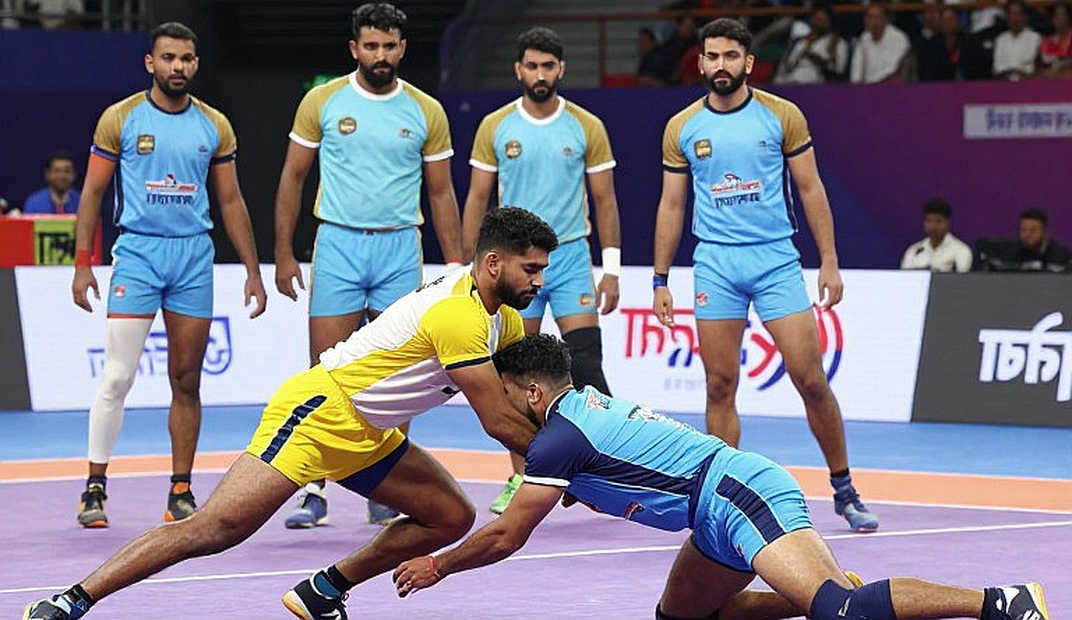
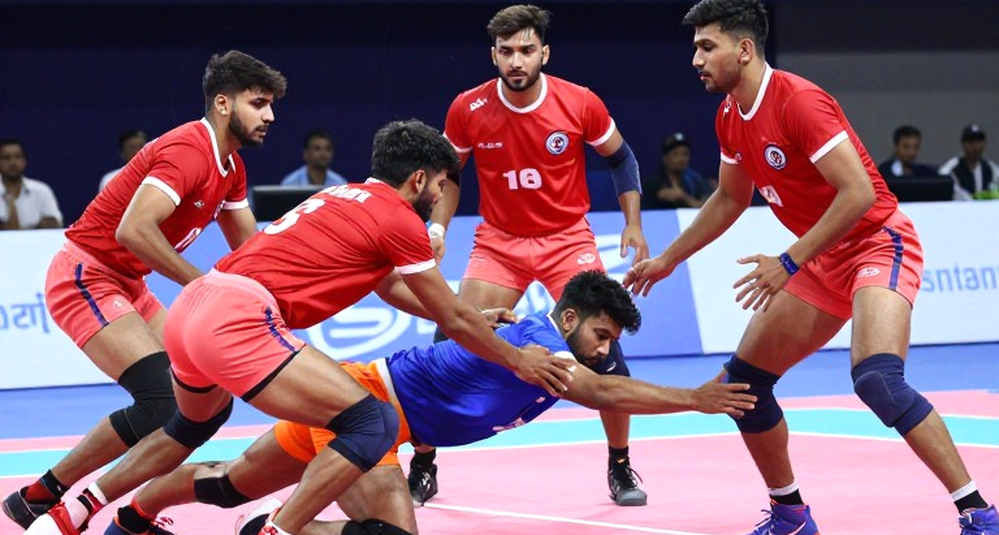
A tackle is no ordinary grab. Every defender must commit fully to the raider — catching an ankle, seizing the waist, gripping with both hands, or circling behind to push him across the boundary line. The rules also state that if any part of the raider goes out of bounds during a tackle, the point goes to the defence. A defender's real skill, then, lies not in grabbing but in trapping the raider at the right angle and the right moment. Pushing him inward and then turning him towards the lobby boundary is all decided in degrees.
The arithmetic of scoring is simple, but its effect is complex. As many defenders as are touched in a raid, that many points — touch points. One point for a successful tackle. One additional point for crossing the bonus line and returning. And when every player of the opposing team is out, an “all out” or “lona” occurs, carrying two extra points and bringing all out players back onto the mat. This all out is the moment when the entire momentum of a match tilts. That two- or three-point jolt often turns into a twenty-point gap, because one team remains weakened for several raids.
The physical demands of the sport are highly specific, and this is what separates it from other team games. To weave through three to five defenders while chanting continuously, bent low and changing direction at speed for thirty seconds is simultaneously a test of anaerobic capacity, lung power and lower-body strength. A raider needs as much control over his body as a wrestler; a defender must go from standstill to full sprint in a single instant. Load on the knees, ankles and shoulders is heavy, which is why modern training gives as much priority to mobility, strength and recovery as to match practice.
The professional turn of the last decade has changed kabaddi considerably. Franchise-based leagues placed the sport inside stadiums, television and branding. Playing on a mat altered the nature of injuries, accelerated the game, and introduced new rules such as the super raid, super tackle and do-or-die raid. The effect has been to make the raider's role even more central while also raising the strategic value of defence, since a super tackle can now flip a match in one stroke. Commentary, data analysis and player scouting are all products of this professional ecosystem.
Women's kabaddi has taken a separate and faster route. Technically it differs little from the men's game — the rules are the same, the basics of raiding are the same — but the court is smaller and the rhythm correspondingly quicker. Visibility for women's kabaddi has grown at both domestic and international levels, though financial and structural support remains unequal compared with the men's game. That inequality is not only about money; it is also about coverage, access to grounds and scouting opportunities at junior level.
Internationally, kabaddi's place is now secure. It has been part of the Asian Games and is played in several formats across many countries. Yet a major obstacle to global expansion remains — the sport's popularity is still geographically concentrated. As for local tradition, kabaddi's greatest strength is its accessibility. It needs no infrastructure to play; a patch of earth and two groups of seven children will do. This is why the sport has kept producing talented players from villages, schools and small towns — players who forged their technique not in formal academies but in daily competition.
But this accessibility comes with a weakness. At grassroots level, shortages of grounds, mats, trained coaches and medical support remain common. Many talents fail to progress simply because the right platform does not arrive at the right time. A second challenge is the sport's duration and physical load — as match density has increased, so has the number of injuries, and insufficient recovery time shortens careers. A third is the constantly shifting shape of the rules, which makes the game more exciting for viewers but forces players and coaches to adapt afresh each time.
Taken together, kabaddi is a sport with a unique balance of technique and instinct. No ball, no equipment — only body, breath and collective understanding. When a raider slips between three defenders and returns safely, he is not merely earning a point; he is showing how the right decision is made in a single pressured second. And when a defender traps that same raider at the boundary, he proves that reaction can be as deliberate as initiative. It is this dual character that makes kabaddi not just a sport but a stage where physical courage and collective intelligence are tested within the same minute.
संबंधित खिलाड़ी
अनुशंसित
Ahmedabad's First Evening: The Points Table Ranked Teams That Never Took the Mat2026-10-25
Raid Success Rate Is the Number That Explains a Whole Season — and Nobody Prints It2026-10-25
Commonwealth Kabaddi Championship 2026: No Broadcaster, No Team List — What Is Ahmedabad Actually Selling?2026-10-24
Surjeet Singh Captain, Naveen Kumar Deputy: The Real Commonwealth Championship Story Was Never in the Press Release2026-10-30
Commonwealth Kabaddi Championship 2026: India's Real Test Against England Isn't on the Scoreboard, It's on the Team Sheet2026-10-24
Commonwealth Kabaddi Championship: The Number 23 Hidden Inside 62 Will Decide the 2030 Argument2026-10-24